 Flyaford
Flyaford
Flyaford
Explore our premier lineup of UL94 V-0 flame-retardant, high dielectric strength standoff insulators engineered for electrical control panel builders, switchgear OEMs, and global exporters.
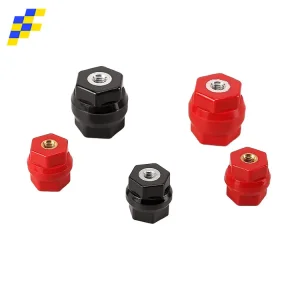
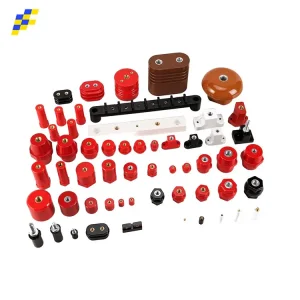
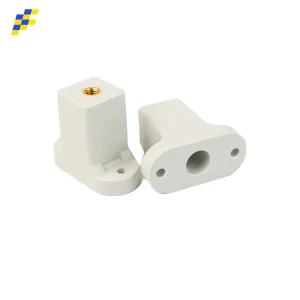
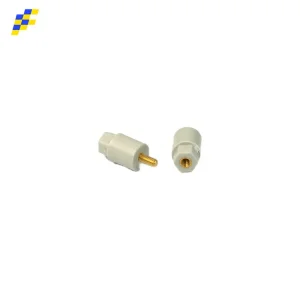
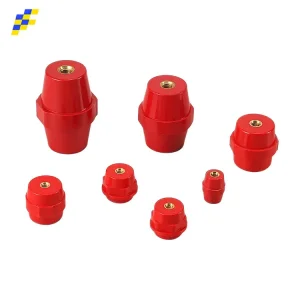
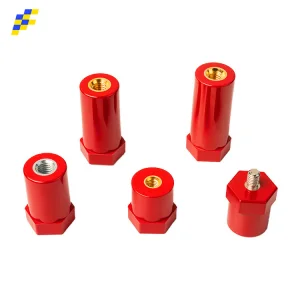
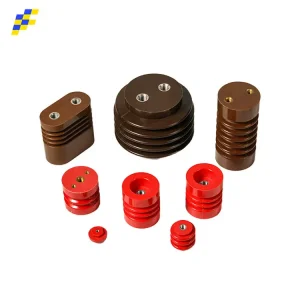
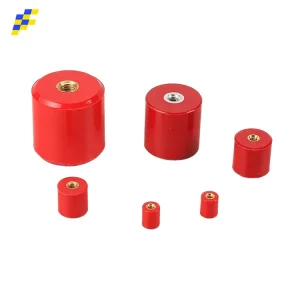
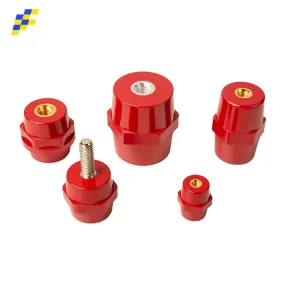
Meeting the demands of global power grid modernization, renewable energy integration, and high-density industrial control panel architectures.
Modern electrical distribution switchboards and control cabinets operating under IEC 61439 and UL 891 standards face extreme electromechanical stresses during short-circuit occurrences. Bulk Molding Compound (BMC) and Sheet Molding Compound (SMC) standoff insulators act as crucial structural anchors that isolate live copper busbars from grounded cabinet enclosures. Our engineered polyester composite insulators provide high flexural strength (up to 120 MPa) and high cantilever load capacity, preventing busbar deformation, arc flashes, and catastrophic phase-to-ground faults in commercial power systems.
From offshore wind turbine nacelles to desert solar inverter stations and chemical processing switchgears, busbar insulators must endure volatile microclimates. Standard insulation components degrade when exposed to continuous moisture, corrosive gases, and thermal cycling. Flyaford's thermosetting polymer composite formulations achieve a CTI (Comparative Tracking Index) > 600V and maintain zero tracking under salt spray exposure. Designed for continuous duty at temperatures ranging from -40°C to +140°C, our insulators prevent creepage currents and flashover hazards across diverse global installations.
Technical Information Gain: Unlike basic plastic insulators that suffer from thermal deformation and tracking breakdown under heavy electrical loads, thermosetting composite BMC/DMC insulators feature non-melting polymer matrices combined with short glass fibers and aluminum trihydrate (ATH) flame retardants. This creates an inert barrier that self-extinguishes within 10 seconds (UL94 V-0 standard) while sustaining high dielectric withstand voltages exceeding 12 kV for 1 minute.
ZHEJIANG FLYAFORD ELECTRON CO., LTD. — Setting global benchmarks in medium and low-voltage insulator manufacturing since 2007.
Operating out of the Jinyi New District in Jinhua City, Zhejiang Province, our facility features over 60 automated thermosetting composite compression molding machines and 20+ specialized electrical/mechanical testing units. Driven by digital process control, our intelligent factory monitors pressure curves, mold temperatures, and curing cycles in real-time. This automation ensures exceptionally consistent mechanical density, precise insert position tolerances, and an overall product defect rate below 100 PPM across large-volume OEM production runs.
Recognized as a "National High-Tech Enterprise" and "Zhejiang Provincial Specialized, Refined, Distinctive, and Innovative SME", Flyaford houses the Jinhua Feifaf High-Performance Insulator R&D Center. Our engineering team collaborates directly with prestigious academic institutions, including Tsinghua University and Hangzhou technology centers. As a designated insulator supplier for Tsinghua research labs, we consistently push the boundaries of high-temperature polymer matrix design, composite insert bonding, and arc-resistance formulation.
To guarantee that every batch meets rigorous OEM specifications, Flyaford operates a state-of-the-art testing facility equipped with instrument setups covering every critical insulation vector:

Our robust quality management system satisfies stringent international standards for automotive, power grid, and industrial control systems.
Flyaford operates under certified management standards including IATF 16949 (International Automotive Task Force quality system), ISO 9001 (Quality Management), and ISO 14001 (Environmental Management). Our insulation products hold safety certifications such as UL Recognition and CE EU Safety Certification. Full raw material and finished product compliance reports for RoHS 2.0, REACH, and UL flame safety are maintained for seamlessly exporting components worldwide.

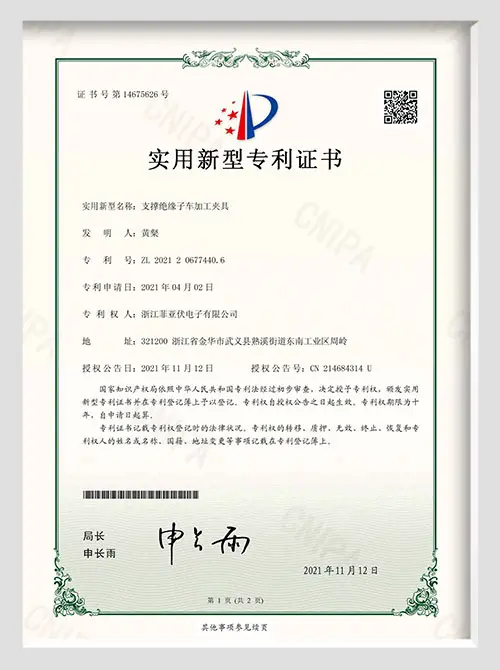

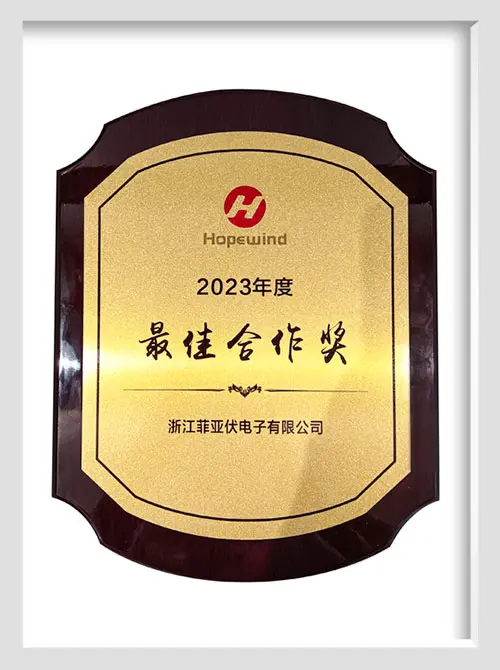
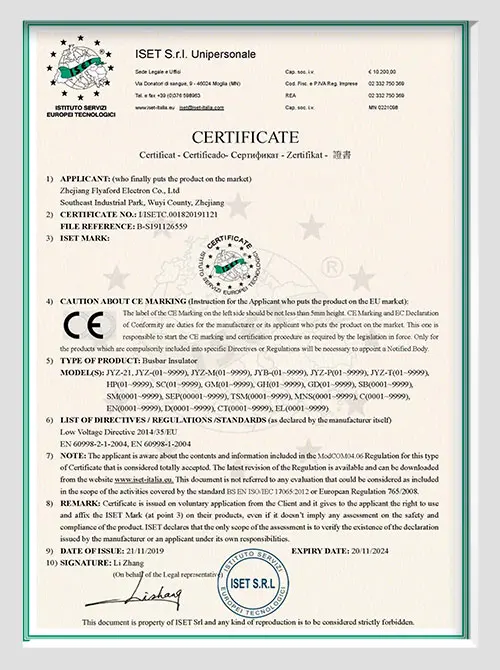
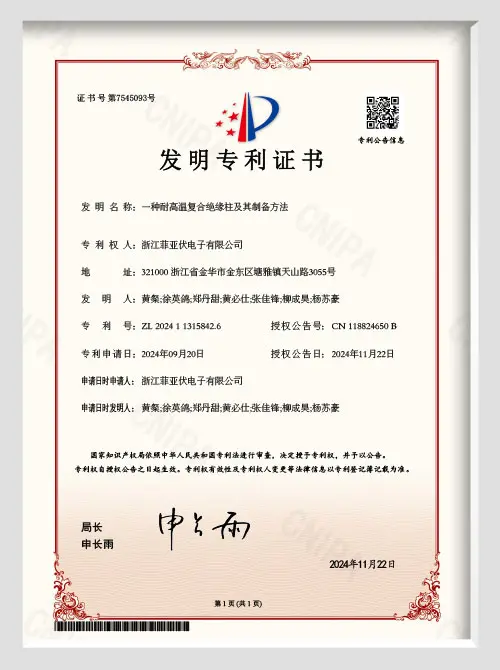
Engineered specifically for low to medium-voltage electrical architecture, switchgear panels, energy storage systems, and smart equipment.

Providing rigid electrical isolation and mechanical support for main copper busbars in power distribution cabinets, MNS low-voltage switchboards, and compact substations.

Mitigating harmonic currents, electromagnetic interference (EMI), and high-frequency thermal dissipation in specialized industrial motor drive enclosures.
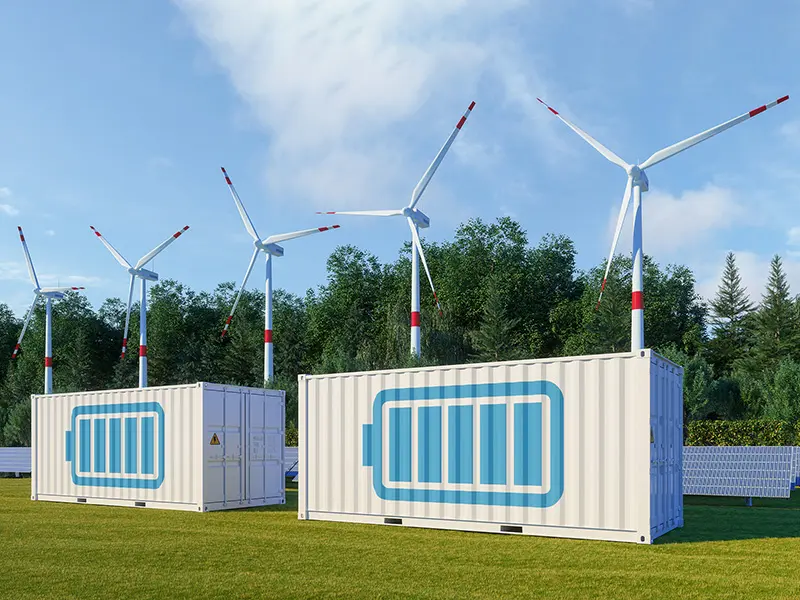
Delivering high dielectric isolation and vibration resilience in heavy-duty battery rack busbars, containerized power conversion systems, and DC disconnect units.

Resisting continuous operational vibrations and extreme microclimate fluctuations within nacelle control panels and tower base transformer switchgears.
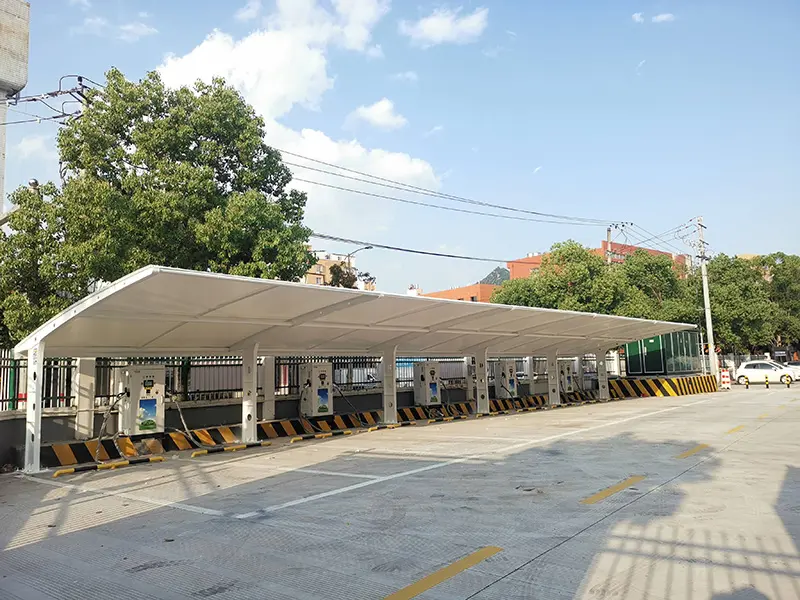
Automotive-grade IATF 16949 certified standoff busbar supports for DC ultra-fast charging stations, commercial fleet power cabinets, and onboard power units.

Compliant with demanding flame retardancy and smoke emission standards for commercial high-rise power distribution risers and railway traction sub-stations.
Over 20 years of bespoke insulator design, tool development, mold building, and insert co-molding capabilities.
Detailed technical evaluation of voltage ratings, thermal limits, creepage distance, tensile strength, and thread insert configurations based on your 2D/3D CAD drawings.
Custom compound optimization selecting BMC, DMC, SMC, or Phenolic (PF) formulations paired with automated brass or steel threaded insert tooling.
Rapid initial sampling and mechanical test verification to validate torque limits, verticality, partial discharge, and dielectric strength prior to mass production.
Scalable, high-speed automated compression molding capable of producing 200,000+ units per day with strict 100% appearance and electrical inspection modes.
We support international control panel builders and switchgear export manufacturers with responsive after-sales service:
Engineering parameters across our core standardized product families. Custom dimensions and thread sizes are available upon request.
| Insulator Series | Material Formulation | Rated Voltage (kV) | Tensile Strength (N) | Torque Strength (N·m) | Flame Retardancy | Thread Insert Sizes |
|---|---|---|---|---|---|---|
| D Series (D-Type) | BMC / DMC Composite | 0.6 kV – 3.3 kV | 3,000 – 12,000 N | 15 – 80 N·m | UL94 V-0 | M6 / M8 / M10 / M12 |
| EL Series | Polyester Composite (BMC) | 1.1 kV – 12 kV | 5,000 – 18,000 N | 25 – 120 N·m | UL94 V-0 | M8 / M10 / M12 / M16 |
| MNS Series | High-Density BMC | 0.6 kV – 1.1 kV | 4,000 – 10,000 N | 20 – 70 N·m | UL94 V-0 | M6 / M8 / M10 |
| P Series (Standoff) | DMC Flame-Retardant Resin | 0.4 kV – 1.1 kV | 2,500 – 8,000 N | 10 – 50 N·m | UL94 V-0 | M4 / M5 / M6 / M8 |
| SB Series | Glass-Reinforced BMC | 1.1 kV – 6.6 kV | 6,000 – 22,000 N | 30 – 150 N·m | UL94 V-0 | M8 / M10 / M12 / M16 |
| SM Series | Thermosetting BMC/PF | 0.6 kV – 2.5 kV | 3,500 – 14,000 N | 18 – 90 N·m | UL94 V-0 | M6 / M8 / M10 / M12 |
| SEP Series | Advanced Composite Polymer | 1.1 kV – 10 kV | 5,500 – 20,000 N | 28 – 140 N·m | UL94 V-0 | M8 / M10 / M12 / M14 |
| T Series (Busbar) | High-Strength BMC | 0.6 kV – 3.3 kV | 4,500 – 15,000 N | 22 – 110 N·m | UL94 V-0 | M6 / M8 / M10 / M12 |
Pioneering composite breakthroughs to support higher power density, elevated system voltages, and eco-friendly smart grids.
Advancing eco-conscious composite matrix formulations that eliminate halogenated flame retardants while retaining strict UL94 V-0 compliance, minimizing toxicity and smoke opacity during extreme thermal events.
Integrating embedded fiber-optic or passive RFID micro-sensors within standoff insulators to enable continuous real-time temperature, mechanical stress, and leakage current telemetry in digital sub-stations.
Incorporating nano-silica and graphene micro-fillers into Bulk Molding Compounds (BMC) to boost flexural strength by 45% and elevated thermal dissipation for ultra-compact control cabinets.
Collaborating with international power equipment leaders, research institutes, and academic centers worldwide.







Expert answers to common technical queries from electrical engineers, procurement managers, and switchgear switchboard manufacturers.
Our standoff insulators are manufactured primarily using Bulk Molding Compound (BMC), Sheet Molding Compound (SMC), Dough Molding Compound (DMC), and Phenolic Resins (PF). BMC is a thermosetting composite composed of unsaturated polyester resin, short glass fiber reinforcement (15–30%), and inorganic mineral fillers such as Aluminum Trihydrate (ATH). This matrix delivers excellent arc resistance, non-flammability (UL94 V-0), high mechanical strength, and minimal thermal degradation compared to standard thermoplastic insulators like polyamide or PVC.
Every standard and custom insulator incorporates precision-machined brass, zinc-plated steel, or stainless-steel threaded inserts (M4 to M16). These inserts are co-molded directly into the composite body during high-pressure thermosetting compression, creating a mechanical interlocking geometry. We verify insert retention via microcomputer torsion testing equipment (0–500 N·m) to guarantee that insert pull-out and rotational torque limits comfortably exceed standard electrical assembly wrench torque specifications.
Our insulators are designed to comply with international standards including IEC 61439-1/2, IEC 60664-1, UL 891, and UL 94. Creepage distance (the shortest path along the insulator surface between two conductive inserts) and clearance distance (the shortest distance through air) are engineered to prevent dielectric breakdown and surface tracking. With a Comparative Tracking Index (CTI) rating of 600V, our insulators allow compact panel sizing while maintaining certified safety margins up to 12 kV impulse withstand voltage.
Yes. As a direct OEM/ODM manufacturer with 26 patents and an in-house tooling center, we specialize in custom insulator geometry design, insert engineering, and specialized thermosetting material selection. We can work directly from your 3D STEP/IGES CAD files to produce custom molds within 15–25 days, followed by rapid sample production and mechanical testing.
With a modern 35,000 square meter factory equipped with over 60 automated compression molding machines, Flyaford produces more than 200,000 insulator units daily. Operating under strict IATF 16949 automotive-grade quality controls and full electrical/visual automated inspection, our factory-wide defect rate is consistently maintained under 100 PPM (Parts Per Million).
Absolutely. All raw thermosetting resins, glass fiber strands, ATH flame retardants, and metallic inserts are thoroughly screened and tested. We maintain official third-party inspection documentation verifying complete compliance with EU RoHS 2.0 (Directive 2011/65/EU and 2015/863) and REACH (EC 1907/2006 SVHC) requirements for hazardous substances.
Thermosetting BMC/DMC composites do not melt, soften, or undergo plastic deformation under thermal stress. Flyaford insulators undergo thermal shock chamber testing ranging from -40°C up to +140°C, as well as high-temperature oven aging up to 300°C. They maintain structural integrity and electrical insulation capacity across extreme outdoor ambient conditions, including desert solar farms and sub-zero wind power enclosures.
We provide comprehensive documentation packages for international importers, panel builders, and EPC contractors. Available certificates include IATF 16949, ISO 9001, ISO 14001, CE Declaration of Conformity, UL Recognition, EcoVadis sustainability rating, and batch-specific Material Test Certificates (MTC) detailing dielectric and mechanical test results.
Select from our certified low-medium voltage insulator catalog or submit your OEM specification drawings directly to our engineering team.