 Flyaford
Flyaford
Flyaford
Explore our flagship low- and medium-voltage standoff insulators and busbar supports certified for global switchgear applications.

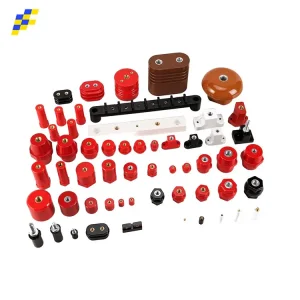
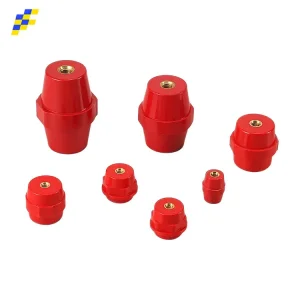
Founded in 2007, Zhejiang Flyaford Electron Co., Ltd. is located in the Jinyi New District of Jinhua City, Zhejiang Province. Operating from a modern 35,000-square-meter standardized industrial campus, we operate as a specialized high-tech enterprise integrating R&D, advanced composite molding, precision hardware insert machining, and rigorous testing for low-to-medium voltage insulating products.
Recognized as a National High-Tech Enterprise and a Zhejiang Provincial Specialized, Refined, Distinctive, and Innovative SME, Flyaford houses the Jinhua High-Performance Insulator Science and Technology R&D Center. Through our close research collaborations with Tsinghua University and top regional engineering institutes, we push the frontiers of composite dielectric chemistry and high-reliability structural design.
Equipped with more than 60 high-precision thermosetting molding presses and over 20 automated inspection facilities, our facility achieves a daily output exceeding 200,000 units. Our digitalized smart factory monitors key molding parameters in real time, guaranteeing product defect rates remain strictly below 100 PPM.
We maintain full compliance with IATF 16949 (Automotive Quality Management Standard), ISO 9001, ISO 14001, CE, and UL certifications. All raw composite formulations (BMC, EMC, DMC, Phenolic resins) comply fully with EU RoHS 2.0 and REACH environmental directives.
A comprehensive analysis of dielectric stress, thermal management, and composite polymer chemistry in space-constrained switchgear architecture.
As modern power grids transition toward localized renewable generation and urban high-density substations, switchgear footprint reduction has become paramount. Modern compact switchgear units—including Gas-Insulated Switchgear (GIS), Solid-Insulated Switchgear (SIS), and Air-Insulated Switchgear (AIS)—require standoff insulators that deliver unyielding dielectric breakdown resistance, zero tracking under extreme humidity, and high mechanical cantilever strength despite reduced creepage paths.
The structural integrity of a busbar standoff insulator relies fundamentally on polymer composite chemistry. Selecting the appropriate matrix material ensures long-term operational safety under thermal cycling, short-circuit mechanical stress, and ambient environmental degradation.
| Material Grade | Composition Profile | Dielectric Strength | Comparative Tracking Index (CTI) | Thermal Resistance | Key Switchgear Applications |
|---|---|---|---|---|---|
| BMC (Bulk Molding Compound) | Unsaturated polyester, glass fiber (15-20%), mineral fillers, catalysts | ≥ 20 kV/mm | CTI 600 (PLC 0) | UL 94-V0 (-40°C to +140°C) | Standard LV/MV busbar standoffs, SM/SEP series insulators |
| DMC (Dough Molding Compound) | Dough-like polyester matrix, short glass fibers, structural resins | ≥ 18 kV/mm | CTI 600 | UL 94-V0 (-30°C to +130°C) | P-Series standoff insulators, distribution switchboards |
| EMC (Epoxy Molding Compound) | Epoxy resin base, silica/glass reinforcement, anhydride hardeners | ≥ 25 kV/mm | CTI 600+ / High Arc Resistance | Continuous operating temp up to 180°C | High-stress MV GIS/SIS switchgear, energy storage breakers |
| PF (Phenolic Resin Compound) | Phenol-formaldehyde thermoset with organic/inorganic fillers | ≥ 15 kV/mm | CTI 175 - 400 | Excellent heat retention up to 200°C | High-temperature industrial cabinets, legacy power units |
In compact switchgear design, internal air gaps are minimized to reduce cabinet dimensions. Consequently, electrical clearance and creepage distance (the shortest distance along the surface of the solid insulating material between two conductive parts) must be engineered meticulously according to IEC 61439-1 and IEC 62271 standards.
Flyaford’s engineering team utilizes finite element electric field simulation (FEA) to design outer skirt profiles (corrugations) on series like the SEP and SM models. These ribbed structures increase the effective creepage length by up to 45% without increasing overall component height. Furthermore, our formulation of non-hygroscopic polyester resins prevents surface moisture film formation, effectively eliminating flashover risks caused by surface tracking in humid marine or tropical environments.
Insulator failures in high-vibration environments (such as wind turbine nacelles, rolling stock railway infrastructure, and heavy industrial plant breakers) frequently stem from insert pull-out or internal cracking. Flyaford integrates heavy-duty brass (H59/H62) or zinc-plated steel knurled inserts into the compression molding process.
Through proprietary insert geometry and automated thermal preheating, internal thermal expansion coefficient (CTE) mismatches between metal inserts and polymer matrices are neutralized. Our automated micro-computer torsion testing guarantees thread pull-out forces up to 500 N.m and cantilever mechanical strength up to 200 kN, protecting busbar configurations during catastrophic short-circuit electromagnetic surge events.
Specialized physical geometries and electrical ratings tailored to custom OEM power network requirements.
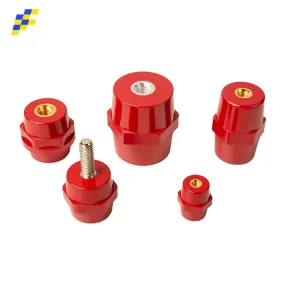
The industry standard for low-to-medium voltage busbar support. Features high mechanical strength, hexagonal center grip for simplified wrench tightening, and molded brass inserts from SM-25 to SM-76.
Primary Use: Low voltage switchboards, power distribution panels, control cabinets.
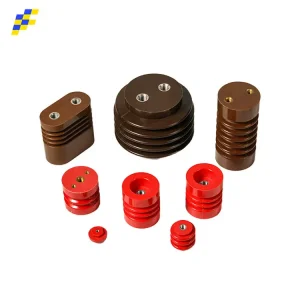
Engineered with extended deep-skirt corrugation profiles to maximize surface tracking distance. Certified for harsh environmental operational profiles including marine, offshore wind, and chemical plants.
Primary Use: Shipping power networks, outdoor compact enclosures, medium voltage breakers.
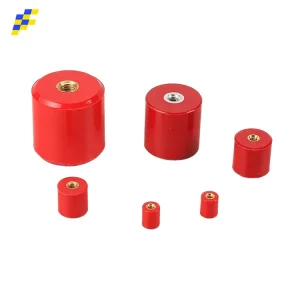
Cylindrical and drum-shaped standoff designs engineered for high compressive force tolerance. Excellent thermal dissipation characteristics and high flame retardancy under UL 94-V0 standard.
Primary Use: Variable frequency drives (VFD), inverter panels, heavy current busbars.
Heavy-duty structural insulation posts with stepped dielectric barrier flanges. Designed specifically to withstand high lateral short-circuit magnetic repulsion forces between heavy copper busbars.
Primary Use: Main distribution switchgear, transformer busbar connections.
Modular insulation supports designed for standard drawer-type low-voltage switchgear cabinets (e.g., MNS, GCS, GCK systems). Provides precise alignment for plug-in busbar connectors.
Primary Use: Draw-out switchgear cabinets, motor control centers (MCC).
Low-profile conical and rectangular standoff configurations tailored for extremely restricted spatial envelopes inside smart compact sub-stations and telecom power modules.
Primary Use: 5G telecom power boxes, micro-inverters, compact solar combiners.
How Flyaford leverages vertical integration, localized raw material ecosystems, and advanced robotics to deliver total cost of ownership (TCO) advantages to global OEMs.
Located in Zhejiang’s industrial heartland, Flyaford maintains direct procurement alliances with Asia's premier glass fiber and thermosetting resin synthesis manufacturers. By processing raw BMC, EMC, and DMC compounds in-house, we eliminate intermediate supply margins, ensure resin freshness, and maintain full control over material purity.
This vertical integration translates into a minimum 15% to 25% Total Cost of Ownership (TCO) reduction for international procurement managers compared to European or North American domestic component sourcing, without sacrificing material performance or UL compliance.
Precision insulation manufacturing begins with mold engineering. Flyaford houses an in-house tooling center equipped with high-speed CNC machining centers, EDM spark erosion equipment, and mold flow analysis software. Our tooling engineers design multi-cavity compression molds that optimize resin curing cycles while ensuring dimensional tolerances within ±0.05mm.
With over two decades of OEM/ODM custom development experience, we turn customer CAD concepts into physical validated samples in as little as 10 to 15 business days.
Quality reliability at Flyaford is backed by an extensive, high-specification laboratory center. Every batch of production undergoes rigorous testing protocols before dispatch:
Adapting electrical insulation technologies to green power grids, SF6-free switchgear, and demanding localized environmental conditions.
Offshore wind installations subject electrical components to continuous salt-spray corrosion, high humidity, and severe vibration. Flyaford's SEP and SM series insulators utilize specialized BMC formulations with high hydrophobic properties and reinforced brass inserts, ensuring zero tracking failure in offshore nacelle converters.
Utility-scale Battery Energy Storage Systems (BESS) operate under elevated DC voltage stresses and high thermal flux. Our EL and P series insulators deliver superior arc quenching and thermal dissipation up to 180°C, supporting safe high-current DC busbar routing inside modular containerized storage blocks.
Megawatt-level electric vehicle chargers demand ultra-compact low-loss busbar isolation components capable of handling rapid switching transients. Flyaford provides specialized micro-standoffs that eliminate partial discharge risks in liquid-cooled power conversion modules.
With global climate regulations phasing out Sulfur Hexafluoride (SF6) gas due to its high global warming potential (GWP), grid operators are adopting Solid Insulated Switchgear (SIS) and Fluoronitriles gas mixtures. Flyaford’s high-dielectric Epoxy Molding Compounds (EMC) provide the primary solid insulation shell required for next-generation green switchgear units.
Mission-critical telecom power supplies demand compact standoff insulators that operate continuously under high thermal density. Flyaford’s BMC standoff components maintain high dimensional stability and dielectric breakdown strength in small power distribution frames (PDF).
Traction power systems experience severe harmonic distortions and intense mechanical vibrations from passing trains. Our dynamic shock-tested resin insulators provide uninterrupted mechanical anchorage and isolation along main feeder lines.
From initial CAD modeling and FEA electric field simulation to mass production and localized compliance assistance.
Our senior electrical engineers evaluate your creepage requirements, mechanical load forces, insert specifications, and spatial boundaries to recommend optimal resin chemistry and geometry.
Rapid precision mold fabrication is conducted in our 35,000㎡ plant. We deliver rapid 3D prototypes or fully molded sample batches complete with material test certificates within 10-15 days.
Using automated compression presses, raw BMC/EMC compounds are molded under controlled pressure and temperature to ensure zero micro-porosity and high dimensional repeatability.
Every insulator undergoes 100% visual inspection and full-batch electrical breakdown testing. Items are packed in export-grade shock-proof packaging with full customs compliance documentation.





Expert engineering answers to common technical, purchasing, and compliance queries regarding compact switchgear insulation.
BMC (Bulk Molding Compound) and DMC (Dough Molding Compound) are thermosetting polyester resins reinforced with short glass fibers, offering an excellent balance of high mechanical strength, flame resistance (UL 94-V0), and cost-efficiency for low-to-medium voltage switchgear. EMC (Epoxy Molding Compound) uses an epoxy resin base, providing superior dielectric strength (≥25 kV/mm), higher thermal tolerance (up to 180°C continuous), and lower partial discharge levels, making it ideal for compact Medium Voltage (MV) gas-insulated and solid-insulated switchgear.
Flyaford embeds high-tensile brass (H59/H62) or electro-galvanized steel knurled inserts directly into the molded polymer body during compression. The insert surface profile features deep diamond-knurled grooves and anti-pull flanges. Furthermore, 100% of production batches are randomly tested on our micro-computer torsion testing machine (0-500 N.m) to verify thread structural integrity under maximum installation torque limits specified by IEC standards.
Yes. Our enterprise operates under certified IATF 16949, ISO 9001, and ISO 14001 quality management systems. Product ranges hold official UL certifications (flammability standard UL 94-V0), CE safety marks, and compliance documentation for EU RoHS 2.0 and REACH environmental regulations, ensuring seamless acceptance by global EPCs and system integrators.
Absolutely. Over 40% of our production consists of custom OEM/ODM solutions. We operate a complete in-house tooling facility capable of designing molds for custom heights, thread insert sizes (metric and imperial M6-M20), specialized mounting bases, and unique skirt geometries. We deliver initial tooling samples within 10 to 15 business days.
Our 35,000㎡ factory operates over 60 automated thermosetting molding presses, achieving a daily output exceeding 200,000 insulator units. Through integrated digital monitoring, automated flash removal, and 100% high-voltage dielectric testing, our product defect rate is controlled strictly below 100 PPM (Parts Per Million).
SEP series insulators incorporate deep exterior corrugation ribs that artificially extend the physical creepage distance across the insulator body by up to 45% compared to smooth cylinders of equal height. Combined with our hydrophobic BMC resin formulation, this design breaks continuous moisture films, maintaining a high Comparative Tracking Index (CTI 600) even in harsh coastal or tropical environments.
Complete your switchgear design with our verified low-to-medium voltage busbar isolation products.