 Flyaford
Flyaford
Flyaford
CE-certified, UL-compliant standoff and busbar insulators engineered for maximum electrical isolation and mechanical strength.
Analyzing the pivotal shifts in modern power distribution, smart grid deployment, and the strict engineering mandates governing low-voltage insulation safety.
In the modern electrical engineering paradigm, Low Voltage (LV) Line Insulators represent a crucial failure-critical component within low-to-medium voltage power distribution networks, industrial control panels, switchgear assemblies, renewable energy hubs, and battery energy storage systems (BESS). As global energy architectures undergo rapid electrification—propelled by utility-scale solar installations, offshore wind farms, hyperscale data centers, and EV charging infrastructure—the demand for ultra-reliable, thermally resilient, and mechanically robust insulation solutions has reached an unprecedented zenith.
As a prominent CE Certification Low Voltage Line Insulator Exporter, Zhejiang Flyaford Electron Co., Ltd. addresses the evolving requirements of EPC contractors, panel builders, and original equipment manufacturers (OEMs) worldwide. Global regulatory frameworks, including the European Union's Low Voltage Directive (LVD 2014/35/EU), IEC 61439 standards for low-voltage switchgear, and North American UL safety norms, mandate absolute dielectric reliability under severe operational conditions. Modern low-voltage systems no longer simply isolate phase-to-phase or phase-to-ground potentials; they must actively withstand transient overvoltages, thermal cycling, aggressive environmental pollutants, high-torque mechanical stresses, and fault-current electromagnetic forces.
Surging global transition toward high-density power distribution requires standoff insulators capable of managing higher ambient temperatures (up to 140°C) without physical degradation.
Global markets strictly demand CE marking and UL compliance. Thermosetting materials (BMC/DMC) must exhibit zero tracking (CTI 600) and self-extinguishing fire resistance (UL 94-V0).
Direct-current (DC) busbar isolation in energy storage systems demands enhanced creepage distances and zero partial discharge under high continuous current density.
A rigorous breakdown of BMC/DMC thermosetting chemistry, mechanical insert bonding, and structural geometry.
The structural integrity of low-voltage insulators relies primarily on thermosetting composite technology. Unlike conventional thermoplastic materials that soften under sustained operational heat, Bulk Molding Compound (BMC) and Dough Molding Compound (DMC) utilize unsaturated polyester resins reinforced with short glass fibers and inorganic mineral fillers (such as aluminum trihydrate for flame retardancy). This creates a cross-linked three-dimensional molecular network that provides extraordinary mechanical strength, thermal endurance, and dimensional stability.
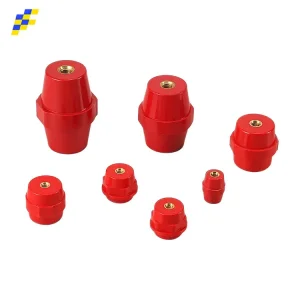
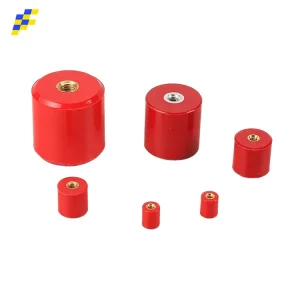
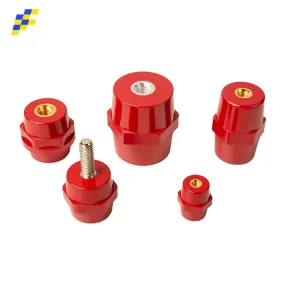
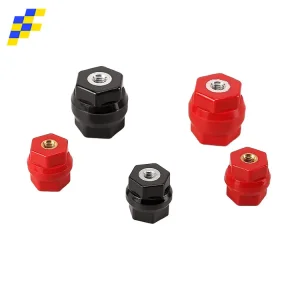
Featuring a classic hexagonal body design with dual-ended brass or steel threaded inserts. Widely utilized in standard low-voltage switchboards and distribution cabinets for securing main copper busbars.
Specifically engineered for modular low-voltage switchgear architectures (such as ABB MNS systems). Optimized for multi-phase busbar clamping with exceptional short-circuit current withstand capacity.
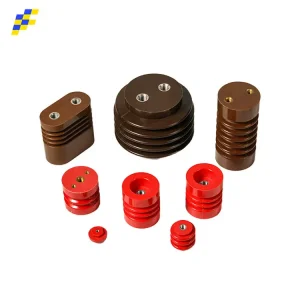
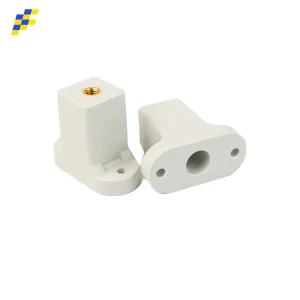
Engineered for compact power electronics, variable frequency drives (VFDs), and specialized railway traction enclosures requiring elevated creepage distances in restricted spatial footprints.
A critical failure mode in low-voltage insulators during installation is insert strip-out or rotational slippage under torque wrenches. Flyaford utilizes specialized knurled insert geometry (diamond or helical knurling) combined with automated pre-heating during compression molding. This ensures an airtight chemical and mechanical bond between the brass insert and the surrounding BMC polymer matrix, raising torsional shear resistance by over 35% compared to post-molding threaded insert installations.
Pioneering high-grade thermosetting formulations, digital simulation, and smart sensor integration for next-decade power systems.
Integration of nano-silica and alumina trihydrate (ATH) nanoparticles within the resin matrix. This increases mechanical flexural modulus, suppresses electrical treeing under high DC stress, and enhances thermal conductivity to dissipate excess heat generated by high-current copper busbars.
R&D focused on bio-based unsaturated resins coupled with halogen-free flame retardants. Achieving UL 94-V0 compliance with zero toxic halogenated emissions during arc flash events, aligning with strict EU REACH & RoHS 2.0 directives.
Employing ANSYS and Moldflow simulation to map thermal expansion stress gradients, insert-to-resin tension zones, and dielectric field concentration. Ensures optimized rib profiles that maximize creepage distance without adding unnecessary mass.
Next-phase integration of passive RFID temperature micro-sensors embedded adjacent to metal inserts. Allows real-time thermal scanning in smart switchgear to detect busbar overheating before catastrophic insulation breakdown occurs.
Located in Jinhua City, Zhejiang Province—Flyaford combines vast manufacturing scale with strict precision quality controls.
Established in 2007, Zhejiang Flyaford Electron Co., Ltd. operates from a modern 35,000 square meter standardized production facility located in the Jinyi New District of Jinhua City. As a recognized National High-Tech Enterprise and Zhejiang Provincial "Specialized, Refined, Distinctive, and Innovative" SME, Flyaford represents the apex of China's electrical insulation manufacturing infrastructure.
Equipped with over 60 high-precision hydraulic thermosetting molding presses. Automated raw material weighing, mold pre-heating, closed-loop pressure monitoring, and robotic demolding ensure continuous 24/7 high-volume manufacturing with exceptional batch-to-batch consistency.
Direct strategic supply partnerships with global raw material leaders for resin, fiberglass strands, and high-purity brass rod stock. In-house compound blending guarantees precise stoichiometry, low moisture absorption, and optimal thermosetting polymerization.
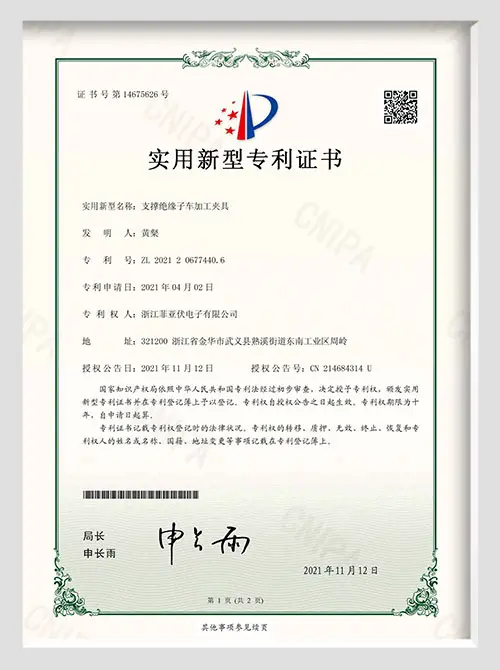
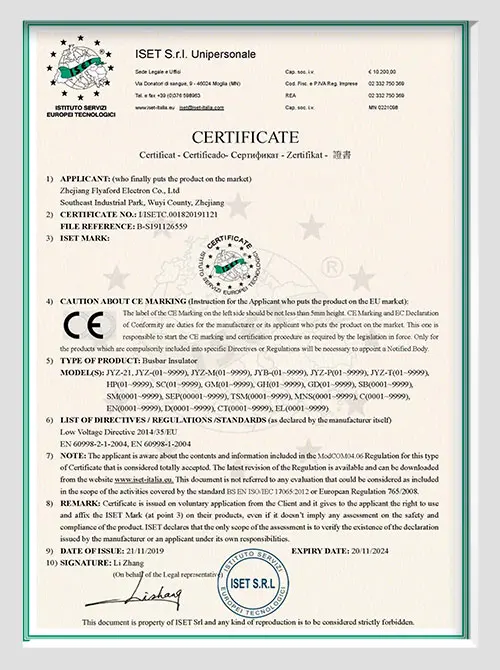
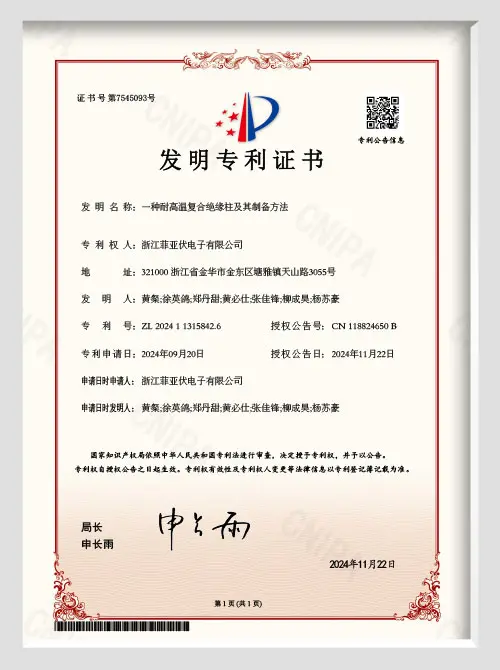
Engineered to international certifications: IATF 16949, ISO 9001, ISO 14001, CE EU Safety, UL, and RoHS 2.0 / REACH.
To assure absolute operating safety across demanding global environments, Flyaford operates a state-of-the-art laboratory equipped with comprehensive physical, electrical, chemical, and environmental testing apparatuses. In strategic collaboration with prestigious academic institutions—including **Tsinghua University** (serving as their designated insulator supplier)—Flyaford advances cutting-edge insulation research through the municipal-level **Jinhua Feifav High-Performance Insulator Science and Technology R&D Center**.
Equipped with Double 85 Test Chambers, Thermal Shock Chambers (-40°C to +140°C), Arc Resistance Testers, Salt Spray Corrosion Chambers, and Vertical/Horizontal Burning Test Apparatus.

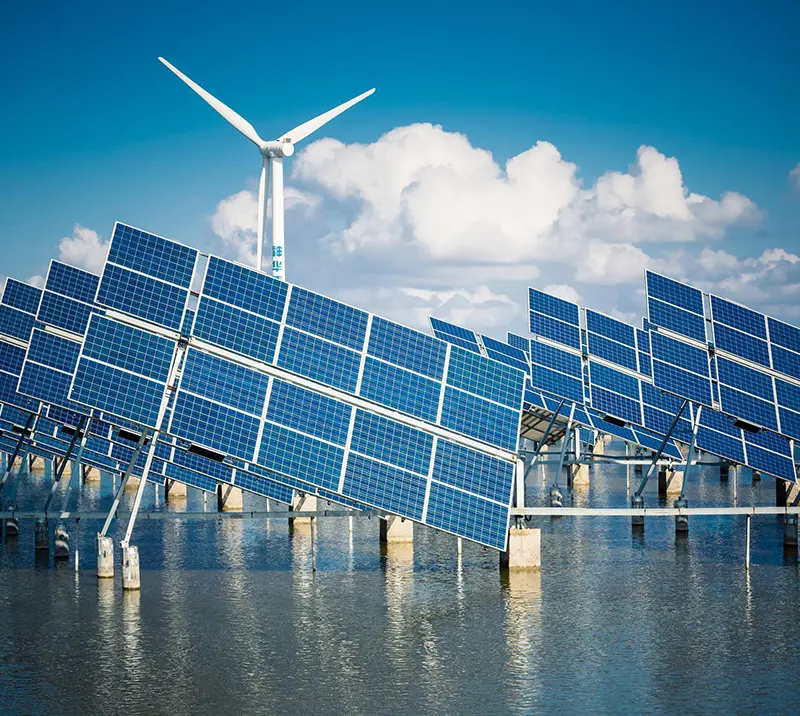
Providing high-reliability isolation across renewable energy, industrial automation, and heavy transportation.



Supports continuous high-frequency switching harmonic currents in VFDs, eliminating thermal hot-spots.
IATF 16949 certified manufacturing for high-voltage junction boxes and automotive charging station busbars.
High dynamic shock load tolerance for trackside power switching sub-stations.
Over 20 years of bespoke OEM/ODM design engineering—from CAD drawing to rapid prototyping and mass delivery.
One-on-one technical evaluation by senior electrical engineers to specify optimal BMC/EMC formulations and insert geometries.
Precision tooling engineering featuring optimized draft angles and ribbing to balance tensile strength and dielectric path lengths.
Rapid prototype casting and 100% full lab validation (torque, flashover, insulation resistance) prior to mold mass production sign-off.
Automated compression molding outputting 200,000+ pcs/day, supported by 7*24 online technical support and guaranteed global export delivery.
In-depth technical responses regarding low-voltage insulator specification, CE compliance, material chemistry, and installation practices.
Direct supply options for global distributors, panel switchboard builders, and industrial power network operators.