 Flyaford
Flyaford
Flyaford
Explore our certified range of low to medium-voltage busbar standoff insulators engineered for extreme short-circuit electrodynamic forces, thermal shock, and aggressive industrial environments.
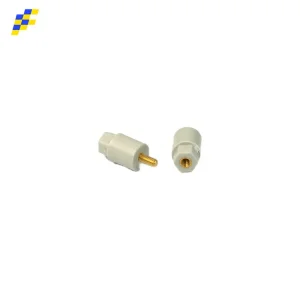
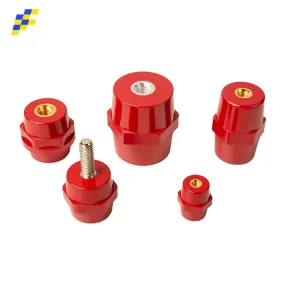
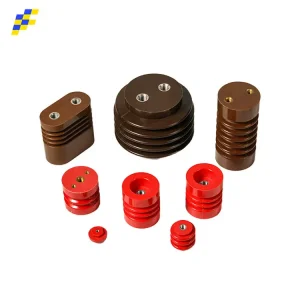
Modern electrical power systems are undergoing a seismic transformation driven by global decarbonization, localized renewable energy generation, and the rapid expansion of electrification across industrial, transport, and communication sectors. Substation busbar insulators, traditionally viewed as passive mechanical supports, are now recognized as critical high-reliability components within smart grid topologies, high-voltage switchgear assemblies, and Battery Energy Storage Systems (BESS).
As power densities increase and equipment footprints shrink, substation busbars are subjected to higher thermal loads, extreme short-circuit electrodynamic forces, and continuous high-frequency harmonic stresses. Electric utilities, switchgear OEMs, and EPC (Engineering, Procurement, and Construction) contractors require advanced composite standoff insulators capable of maintaining electrical clearance and mechanical integrity under adverse conditions, including extreme moisture, salt spray, atmospheric pollution, and seismic shocks.
Solar microgrids, utility-scale BESS, and offshore wind turbines demand DC and high-frequency AC busbar insulation. Insulators must offer exceptional partial discharge mitigation (<5pC) and anti-tracking properties to handle bi-directional power flows and step voltage transients.
Modern GIS (Gas-Insulated Switchgear) and AIS (Air-Insulated Switchgear) require compact standoff insulators with optimized creepage distance to volume ratios. Polymer chemistry advancements allow smaller dimensions without compromising dielectric breakdown thresholds.
Deployments in marine transport, 5G base station power systems, and high-speed railway catenary systems require compliance with rigorous vibration standards, zero-halogen flame retardancy (UL94 V-0), and operational stability across -40°C to +140°C.
Established in 2007 and located in the Jinyi New District of Jinhua City, Zhejiang Province, Zhejiang Flyaford Electron Co., Ltd. has established itself as a global leader in low-to-medium voltage insulation engineering. Spanning a state-of-the-art 35,000 square meter standardized production complex, Flyaford combines advanced thermosetting composite compression molding technology with automated manufacturing to supply premier power infrastructure projects worldwide.
Flyaford operates over 60 high-precision molding machines and over 20 comprehensive testing devices, driven by a dedicated workforce of over 120 industry professionals. Recognized as a "National High-Tech Enterprise," "Zhejiang Provincial Specialized, Refined, Distinctive, and Innovative SME," and host to the "Jinhua Feifaf High-Performance Insulator Science and Technology R&D Center," the company continuously drives technological innovation in partnership with leading academic institutions, including Tsinghua University.
Flyaford is the designated insulator supplier for Tsinghua University, participating in joint industry-university-research programs. Our high-caliber R&D department features senior structural engineers and full-time materials scientists focused on developing ultra-low partial discharge composites and high-torsion structural inserts.
The mechanical stability and dielectric performance of busbar standoff insulators are governed by thermosetting composite formulations and automated molding processes. Flyaford utilizes specialized Bulk Molding Compound (BMC), Sheet Molding Compound (DMC), Unsaturated Polyester (PF), and Epoxy formulations, reinforced with high-purity fiberglass matrix structures.
Utilizing high-tonnage automated compression molding machinery, composite materials are subjected to calibrated temperature profiles and multi-stage pressure cycles. This eliminates internal voids, micro-cracks, and structural delamination, maintaining consistent dielectric constants and high flexural yield strength.
Threaded brass and steel inserts are knurled and surface-treated to guarantee high torque resistance and pull-out force ratings. Insert encapsulation geometries are optimized to equalize thermal expansion coefficient differentials between metal hardware and composite bodies, eliminating mechanical stress cracks under severe thermal cycling.
| Performance Metric | Testing Parameter / Standard | Flyaford Technical Specification |
|---|---|---|
| Dielectric Strength | IEC 60243-1 / GB/T 1408.1 | ≥ 18 kV/mm - 25 kV/mm |
| Flame Retardancy Rating | UL 94 Standard | UL 94 V-0 (Self-Extinguishing within 10s) |
| Insulation Resistance | 0-1 TΩ Tester Range | ≥ 10,000 MΩ (under ambient/humid cycles) |
| Torsional Strength | 0-500 N.m Microcomputer Test | Exceeds IEC 660 standard ratings by 25% |
| Cantilever & Tensile Force | 0-200 KN Universal Tester | Customizable up to 200 kN structural load |
| Comparative Tracking Index (CTI) | IEC 60112 | CTI ≥ 600 V (Specialized anti-tracking series) |
| Operating Temperature Window | Thermal Shock Chamber Test | -40°C to +140°C continuous operational stability |
To maintain an industry-leading defect rate below 100 PPM, Flyaford operates a multi-million-dollar testing laboratory capable of comprehensive physical, electrical, chemical, and thermal verification. Every product line undergoes strict Lot Quality Assurance (LQA) and 100% full-inspection for electrical performance and visual fidelity prior to dispatch.
Equipped with a 0-120kV Partial Discharge Testing Room, 0-300kV Lightning Impulse Tester, 0-100kV Withstand Voltage Tester, and Flash Testers for dielectric breakdown verification.
Utilizes microcomputer-controlled torsion testing machines (0-500N.m) and universal tensile testing machines (0-200KN) to simulate short-circuit electrodynamic loading.
Features Double 85 test chambers (85°C / 85% RH), thermal shock chambers (-40°C to 140°C), ultra-low temperature chambers (-86°C), and salt spray corrosion chambers.
Includes ROHS spectrometer component analyzers, Arc Resistance Testers, Vertical/Horizontal Flammability Test Chambers, and Ball Pressure Testing devices.
Flyaford maintains comprehensive international quality and environmental management compliance credentials:
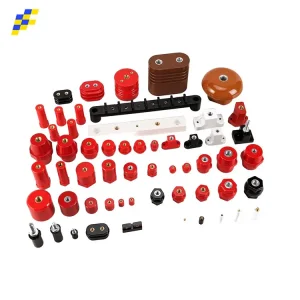
Flyaford manufactures a complete continuum of low and medium-voltage standoff insulators engineered to seamlessly fit into low-voltage switchboards, power distribution cabinets, and transformer substations. Below is an architectural overview of our primary product lines:
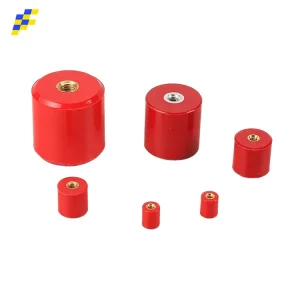
Optimized for low to medium-voltage switchgear and BESS battery module busbar separation. Features cylindrical ribbed geometry to maximize surface creepage path within compact cabinet footprints.
Engineered with high mechanical strength BMC/DMC composite formulations. Designed for demanding switchgear environments requiring exceptional cantilever force resistance and high arc endurance.
Tailored specifically for MNS low-voltage switchgear systems. Provides versatile busbar mounting slots, exceptional flame retardancy, and precision insert tolerances for rapid panel assembly.
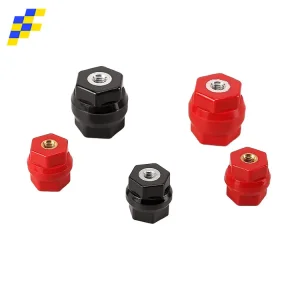
Features hexagonal base profiles for simplified wrench-tightening during installation. Highly resilient to vibrational stress in industrial drives and mobile energy storage containers.
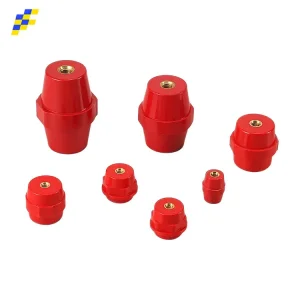
Standardized red/brown composite standoff supports widely utilized across global distribution panels. Rated for outstanding insulation resistance, UL 94 V-0 flame control, and mechanical longevity.
Specialized marine and heavy industrial busbar supports. Engineered to withstand high ambient moisture, salt air exposure, and severe dynamic loading in shipping and offshore platforms.
Flyaford busbar insulator solutions are integrated into high-reliability electrical systems across global infrastructure sectors. Our technical team works directly with project engineers to ensure component specifications match site-specific operational stresses.
Serving as main busbar supports and partition feed-through insulators in primary substations, power plants, and industrial distribution units. Provides reliable separation under 100kA+ short-circuit conditions.
Mitigating high-frequency harmonic heat build-up and voltage spikes in variable frequency drives (VFDs) for industrial automation, water pump stations, and mining equipment.
Insulating DC high-current busbars in containerized battery racks. Materials are certified zero-halogen flame retardant to prevent thermal runaway propagation in renewable energy storage facilities.
Built to withstand continuous structural vibration inside wind turbine towers and ambient temperature extremes (-40°C solar fields to high internal nacelle operating temperatures).
Supporting internal DC fast-charging busbars and step-down transformer cabinets. Fully compliant with automotive IATF 16949 quality framework requirements.
Custom SEP series marine-certified insulators providing anti-corrosion, humidity-resistant, and high-impact insulation for shipboards and railway traction substations.
With over 20 years of dedicated OEM and ODM engineering expertise, Flyaford provides end-to-end custom insulator development. From custom insert tooling and polymer formulation to FEA structural modeling and rapid physical prototyping, our senior engineering team turns complex client specifications into certified production parts.
Reviewing CAD drawings, mechanical load demands (cantilever/torsion), creepage requirements, electrical voltage profiles, and installation ambient conditions.
In-house tooling design utilizing high-grade mold steel to ensure multi-cavity precision, uniform compression pressure distribution, and long mold lifespans.
Manufacturing pilot batches for extensive laboratory validation: dielectric flashover tests, partial discharge verification, salt spray, and mechanical pull-out tests.
Automated compression molding under strict IATF 16949 control, followed by 100% optical and electrical dielectric screening before export packaging.
Choosing Flyaford means acquiring a long-term engineering partnership. We back our wholesale insulator products with structured support mechanisms designed to eliminate field risk and maximize power network operational continuity.
Providing clear performance specifications, installation compatibility analyses, and rapid sample dispatches to empower client testing and evaluation prior to purchase commitments.
Our dedicated electrical engineering desk provides round-the-clock technical guidance regarding mounting torque limits, busbar clearance calculations, and replacement protocols. Enquiries receive formal responses within 2 hours.
In the event of field anomalies, our engineering team executes force reproduction laboratory testing to identify root causes. Non-conforming batches are immediately covered by full replacement or return guarantees.
Find authoritative answers to critical engineering and procurement queries regarding wholesale standoff insulator selection, material standards, and OEM customization.
BMC/DMC composite formulations offer superior mechanical flexibility, higher impact and tensile resistance, and precise dimensional control during molding. Unlike porcelain, composite standoff insulators are non-brittle, eliminating shatter risks during short-circuit electrodynamic shocks or thermal expansion of heavy copper/aluminum busbars. Furthermore, BMC/DMC enables high-precision encapsulated metal inserts, reducing installation complexity and weight.
Partial discharge (PD) is minimized through void-free high-pressure compression molding, optimized insert radii that prevent localized electric field concentration, and rigorous raw material degassing processes. Every production lot destined for medium-voltage switchgear is verified inside our 0-120kV Partial Discharge Test Room to ensure PD levels remain <5pC at operational voltages, preventing long-term dielectric degradation.
All Flyaford BMC, DMC, and polyester insulator formulations achieve UL 94 V-0 flame retardancy rating, meaning flaming combustion stops within 10 seconds on a vertical specimen and drips are non-igniting. Additionally, our materials comply with RoHS 2.0 and REACH environmental regulations, ensuring halogen-free or low-halogen composition to prevent toxic gas emissions in enclosed switchgear rooms or BESS energy storage containers during fire events.
Yes. Flyaford specializes in custom OEM/ODM production. Operating an in-house mold tooling facility and dedicated R&D lab, we design customized molds, engineer custom insert configurations (metric or imperial threads in brass, steel, or stainless alloys), adjust polymer matrices for specific CTI or flexural demands, and provide full prototype verification before high-volume manufacturing.
Improper tightening torque during busbar installation can damage internal threads or crack composite housings if inserts are poorly designed. Flyaford utilizes heavily knurled inserts embedded during hot compression molding, maximizing rotational shear resistance. Our microcomputer torsion testing machine (0-500N.m) verifies maximum torque limits, ensuring installers can achieve recommended bolt torque without risking mechanical failure.
With a 35,000 m² manufacturing plant operating over 60 molding machines, Flyaford maintains a daily output exceeding 200,000 units. Standard product catalog orders are shipped within accelerated timeframes, while custom tooling and prototype cycles typically take 2-4 weeks. Our digital smart factory infrastructure tracks real-time production parameters to ensure consistent lead times for large wholesale orders.
Explore our complete catalog of certified standoff insulator products designed for custom low and medium-voltage power distribution projects.