 Flyaford
Flyaford
Flyaford
Explore our factory-direct, OEM/ODM compliant standoff busbar insulators optimized for fault-current tolerance, high creepage resistance, and zero thermal degradation.
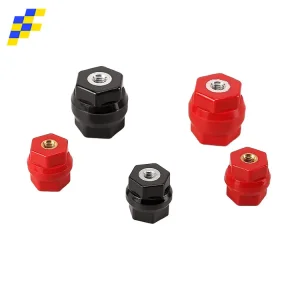
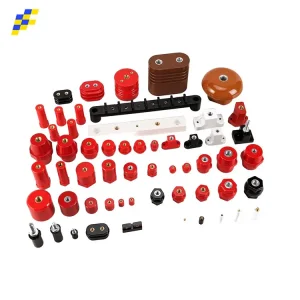
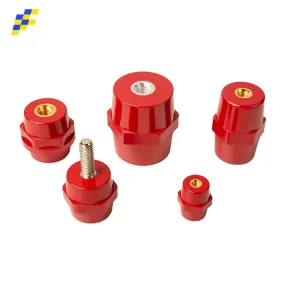
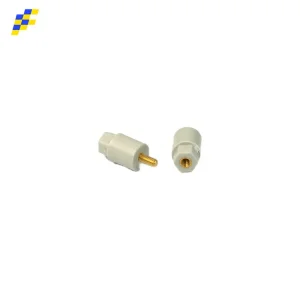
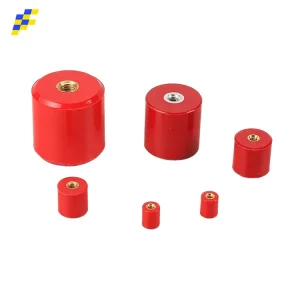
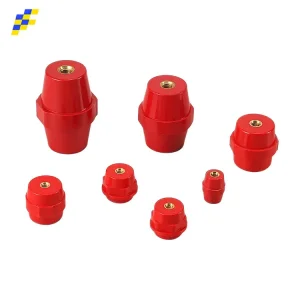

Overload protection insulators serve as the critical mechanical backbone and electrical isolation barrier within modern low-to-medium voltage power distribution networks. When electrical switchgear, variable frequency drives (VFDs), or battery energy storage systems (BESS) experience transient overcurrents or severe short-circuit faults, insulators are subjected to extreme electrodynamic mechanical stresses, localized plasma arcing, and rapid thermal spikes. Selecting high-grade thermosetting polymer insulators over conventional thermoplastics or legacy porcelain is essential for maintaining grid integrity and avoiding catastrophic equipment failure.
Under sudden electrical overload, voltage transients (surge currents) generate severe thermal dissipation challenges. Premium bulk molding compounds (BMC) and epoxy molding compounds (EMC) feature glass-fiber reinforcement intermeshed within thermoset resin matrices. This delivers breakdown dielectric strengths exceeding 20 kV/mm and thermal stability up to 300°C without mechanical softening.
When high short-circuit currents surge through parallel copper busbars, Lorentz forces create violent mechanical bending and cantilever moments. Our high-density D-Type, SM, and MNS standoff series absorb peak dynamic mechanical forces up to 200 kN, protecting the entire enclosure structural matrix from fracturing.
In humid, industrial, or coastal ambient conditions, surface contamination leads to electric tracking and partial discharges. Utilizing UL94 V-0 flame-retardant formulations with Comparative Tracking Index (CTI) ratings of ≥ 600V ensures zero arc-tracking paths, preventing long-term insulation breakdown.
The comparative matrix below details performance advantages across key thermal, electrical, and mechanical indicators:
| Material Parameter / Property | BMC / DMC Thermoset (Flyaford) | EMC / PF Advanced Resin | Electrical Porcelain | Polyamide (Nylon 66) |
|---|---|---|---|---|
| Dielectric Strength (kV/mm) | 18 - 25 kV/mm | 22 - 28 kV/mm | 10 - 15 kV/mm | 12 - 16 kV/mm |
| Flexural Strength (MPa) | 120 - 160 MPa | 150 - 200 MPa | 60 - 90 MPa | 80 - 110 MPa |
| Flame Retardancy (UL94) | V-0 Grade (Self-Extinguishing) | V-0 Grade (Halogen-Free) | Non-combustible | V-2 to V-0 (Hydroscopic) |
| Comparative Tracking Index (CTI) | CTI ≥ 600 V | CTI ≥ 600 V | CTI 600 V | CTI 175 - 300 V |
| Thermal Shock Resistance (-40°C to +140°C) | Superior (Zero Cracking) | Exceptional | Poor (Brittle Fracture) | Moderate (Thermal Creep) |
| Threaded Insert Torque Strength (N.m) | High (Up to 500 N.m) | Ultra-High | Low (Insert Loosening) | Moderate (Thread Stripping) |
ZHEJIANG FLYAFORD ELECTRON CO., LTD. represents the leading edge of Chinese electrical insulation manufacturing. Operating from Jinyi New District, Jinhua City, Zhejiang Province, our intelligent digital facility integrates raw material synthesis, precision molding, insert brass machining, and fully automated testing.
With over 60 high-precision hydraulic compression molding presses, Flyaford produces over 150,000 to 200,000 standoff insulators daily. Fully automated raw material dosing and digital thermal loop monitoring eliminate microscopic voids, ensuring dynamic mechanical homogeneity across every production batch.
Situated in the heart of East China's power equipment hardware hub, Flyaford leverages direct local access to high-grade thermosetting resins, copper/brass insert machining clusters, and efficient multimodal logistics through Ningbo and Shanghai ports, achieving unparalleled lead times and cost-efficiency.
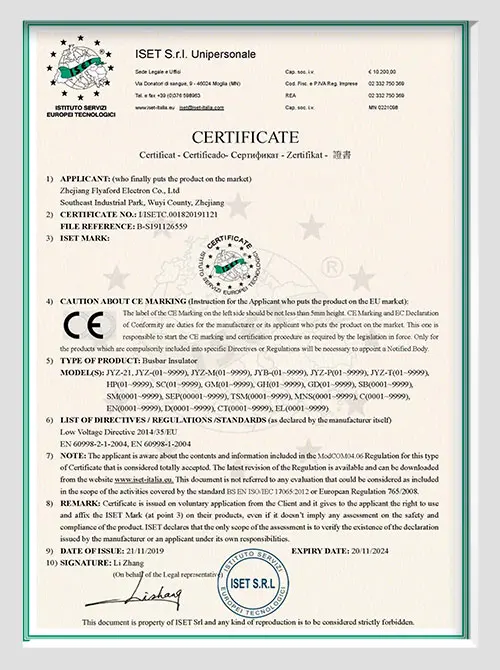
Certified under IATF 16949 (Automotive Quality Management Standard), ISO 9001, ISO 14001, and CE EU Safety directives, every insulator batch undergoes 100% full electrical appearance inspection and batch laser marking for end-to-end component traceability.
Our products comply with global international standards including RoHS 2.0, REACH, and UL94 V-0 flame-retardant standard tests.

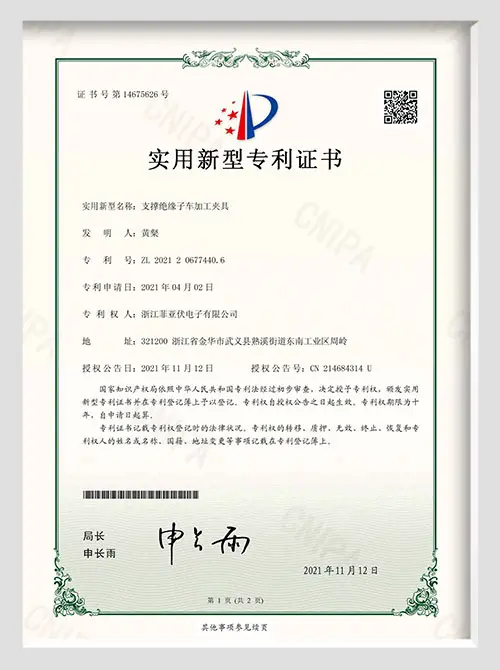


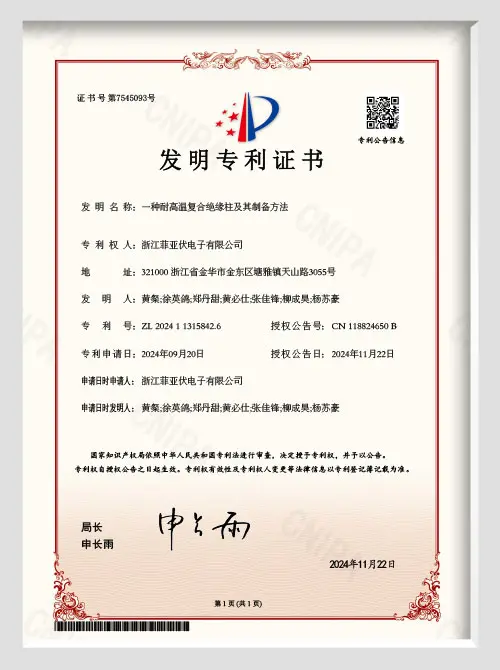

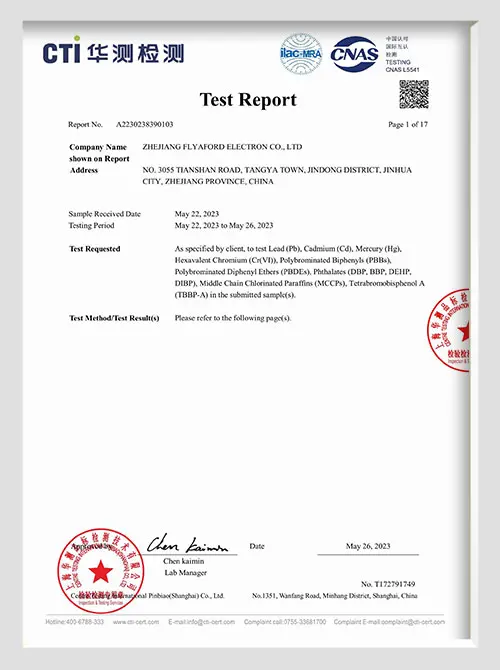
Recognized as the Jinhua Flyaford High-Performance Insulator Science and Technology R&D Center, our organization drives insulation technology forward through rigorous experimental validation and academic research collaboration. We are proud to serve as a designated insulator supplier for Tsinghua University, participating in cutting-edge energy distribution research programs.
Equipped with a microcomputer torsion testing machine (0-500 N.m) and a universal tensile/compression testing machine (0-200 kN), our engineers verify that brass threaded inserts retain zero rotational slip under high installation torque and severe thermal expansion shifts.
Our dedicated high-voltage test room features partial discharge test equipment (0-120 kV), lightning impulse generators (0-300 kV), withstand voltage testers (0-100 kV), insulation resistance meters (0-1 TΩ), and surface arc resistance apparatus to guarantee zero internal discharge voids.
To simulate severe tropical, desert, and polar deployment environments, insulators are tested in high-low temperature thermal shock chambers (-40°C to +140°C), double 85-degree humidity test chambers, ultra-low temperature freezers (-86°C), vertical/horizontal flame chambers, and salt spray fog chambers.
As modern power grids transition toward renewable energy, high-power DC fast charging, and microgrid decentralization, standoff insulators must withstand complex electrical harmonics and continuous overload dynamics across varied operating environments.
High-capacity lithium battery container racks require low-profile, high-strength D-Type and SM standoff insulators to stabilize DC busbars operating up to 1500V DC. BMC insulators prevent thermal runaway propagation while resisting continuous high-current DC arc generation.
Installed inside solar central inverters and wind turbine nacelles, insulators withstand continuous ambient vibrations, elevated operating temperatures, and sudden voltage spikes caused by grid fault ride-through (GFRT) events.
Megawatt-class DC fast-charging stations demand small-footprint standoff insulators capable of enduring rapid load cycles without dielectric deterioration, ensuring long-term driver safety and operational reliability.
Variable frequency control cabinets use SEP, SB, and P-Series standoff insulators to decouple power busbars from control electronics, isolating destructive high-frequency harmonics and voltage reflections generated by fast IGBT switching.
As power grids worldwide upgrade to handle higher energy densities and stricter safety certifications, insulator engineering is undergoing structural transformations. Flyaford's R&D division focuses on three major technological frontiers:
Developing ultra-low smoke density, non-toxic flame-retardant composite resins that replace legacy brominated additives, exceeding international rail transportation safety standards (EN 45545-2) and stringent EU green directives.
Integrating micro-piezoelectric and surface temperature sensors directly into molded standoff insulators to enable real-time wireless monitoring of busbar joint overheating and mechanical strain before electrical flashover occurs.
Utilizing high-resolution finite element analysis (FEA) mold-flow simulations to eliminate microscopic internal voids, optimizing internal fiber orientations to increase cantilever shear strength by over 35% without expanding part footprint.
Flyaford provides an integrated design-to-delivery technical method, assisting clients from initial custom drawing reviews through mold design, insert engineering, prototype sampling, and high-volume delivery.
Our engineering group evaluates operating environments, electrical clearance requirements, and mechanical load specifications to select optimal BMC/EMC formulations.
Custom brass or steel threaded inserts are precision machined and anchored directly within custom-engineered multi-cavity compression tooling.
Parts are molded on automated compression presses, with full 100% inspection covering dimensional tolerances, verticality, torque rating, and electrical insulation resistance.
We provide global 7*24 online technical support, 2-hour rapid inquiry responses, standard product replacement guarantees, and full failure analysis reporting.
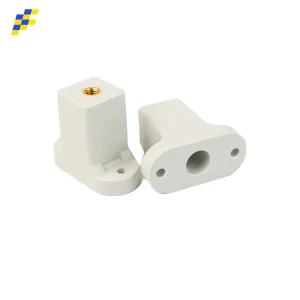
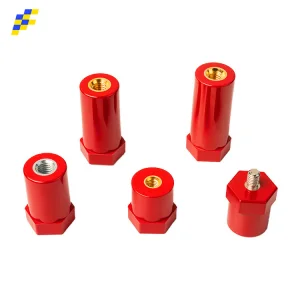
Select from our standard D, EL, MNS, P, SB, SM, SEP, and T-series standoff insulators engineered for immediate global dispatch.
Deep-dive technical answers addressing electrical insulation selection, mechanical load calculations, and environmental compliance.
